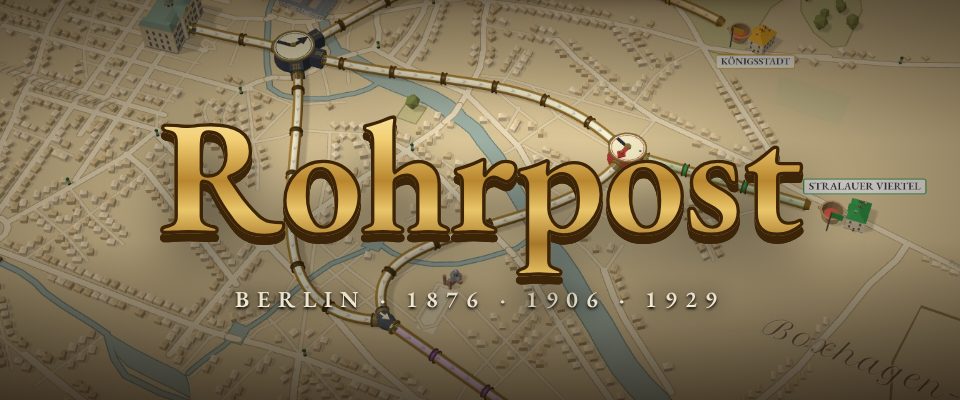
The word Rohrpost in polished brass over a plan of Berlin, with brass tubes and stations. Berlin, 1876, 1906, 1929.

Ludum Dare 60 · theme “Old Tech” · October 2026

Rohrpost: The making of a Ludum Dare game, by Sibi and 137 AI agents

Berlin's pneumatic post as a puzzle: set it up, pull the lever, every capsule changes the network.

Play Rohrpost

Free, in the browser, desktop first. 31 levels, about an hour.

Trailer

The trailer arrives here soon.

The trailer. Under a minute, for sharing.
Film

The film arrives here soon.

How I made Rohrpost. The process in three minutes: the tools, the board, the models, the music and the voice.

I · The game, and who made it

One director, 137 agents

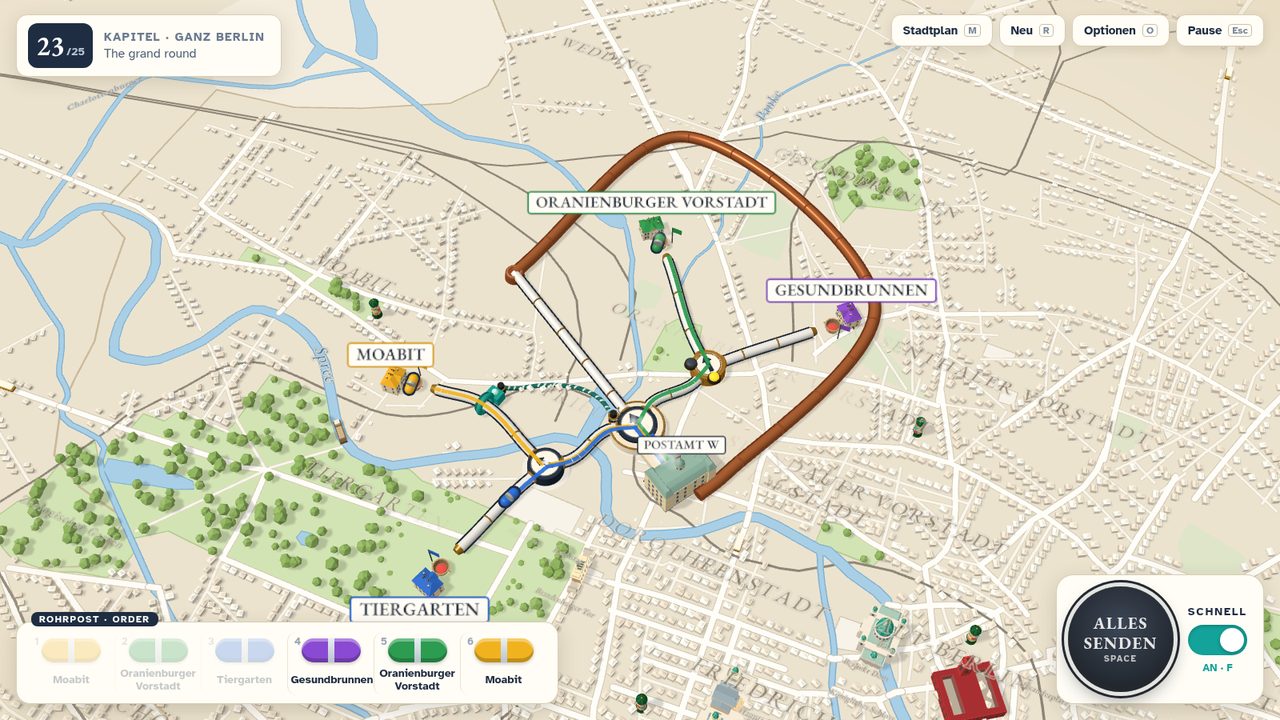
Level 23, “Tangled lines”, in the finished game.

You run Berlin's pneumatic post. Every capsule must reach the station of its colour, and you never steer one in flight.

Sort the capsules, set up the network, and pull the lever: the whole queue flies at once. A diverter sends each capsule the way its arrow points, then flips, so every capsule changes the network for the next one. The stamp says Zugestellt, delivered, or Unzustellbar, and you try again.

Thirty-one levels across three eras of Berlin add counters, sensors on patch cords, a copper return tube and Eilpost capsules that fly past without flipping anything. Every level has exactly one plan that delivers everything, and a solver proves it.

Rohrpost · Berlinfrom the Ludum Dare page

Made by Sibi for Ludum Dare 60.

I made Rohrpost with heavy use of AI tools (mostly Claude). I directed it and made every call on how it plays, looks and sounds. My agents did the production work: the code and the levels; the 3D models, built with Blender scripts; the maps, traced from old plans of Berlin; the music, written as notes and played with sampled instruments; the sound effects, synthesized in code; the layout of this page. The “Zugestellt!” is my own voice. No image, mesh, music or voice generators were used.

Sibi
Sibi did not write code. Sibi played every build, talked to it out loud, and dictated what they saw, sometimes thousands of words at a time. A Claude Opus director turned that into briefs; Claude Sonnet and Codex gpt-6-astra built prototypes; Claude Opus sessions built the game itself, one track each for models, sound, levels, the city map, the eras and the interface. A board on Sibi's own Hub kept the asks short.

Over the weekend Sibi's messages got shorter. Hour-long playthroughs on the first day, single lines by the last evening: “Great, ship it!”

382pull requests
137AI agents
35prototypes
229board tickets
31levels
0lines written by hand

Also: 45 models from Blender recipe scripts · 154 km of brass tube across the 31 levels · 109 capsules to deliver · about 130,000 words dictated · five “Zugestellt!” takes in Sibi's own voice.

II · Ideas

35 prototypes, 20 games

The theme dropped: Old Tech. Sibi was not a fan. “I'm really struggling with this theme. Not my favorite.” Sibi talked through pyramids, Tamagotchis, rotary phones and cave paintings, handed the ideas to a Claude Opus director, asked for ten playable prototypes by morning, and went to bed.

Within a day the swarm had built 35 prototypes of 20 different games, most in 20 to 60 minutes each: Claude Sonnet built 19, Codex gpt-6-astra 16. Sibi played every one and dictated a verdict. Pneumatic tubes came up in a side chat about old technologies: “I like the visual of these things just going through some sort of network. It's always very satisfying and makes a very nice sound.”

Screenshot first

The quality jumped when every brief came with target screenshots of the finished game, made by an image generator before the builder started. “They're basically one-to-one copies of these screenshots.” Drag across the pictures to compare.

The ones to play first

Every Play button opens the real build, exactly as Sibi played it, in a new tab. They are made for a desktop browser.

Everything else that got built

Parked, never deleted. The verdicts are Sibi's, as dictated.

III · The rival

Two cities in one night

Rohrpost won the day. That night two Claude Opus sessions each got the whole night to build a complete version: Stadtplan, the network on a traced 1905 plan of Berlin, 25 levels; and Unter Berlin, a living Berlin street cut open, the brass tubes in the earth below, 26 levels and 19 Blender models. By morning both were finished, polished and playable.

Sibi played both, each for over an hour, dictating along the way. Unter Berlin was the prettier one. It lost anyway, and 35 minutes after the decision its best pieces were inside the winner: the springy diverter arrows, the capsules in glass tubes, the merge fittings, the counter lamps.

The overnight Stadtplan build: brass tubes and a copper return loop on a traced plan of Berlin
ZugestelltStadtplan. “Oh, it's so satisfying. I'm dragging the cable all like this.”
UnzustellbarUnter Berlin. “But this one is so pretty. It's so detailed. I don't know how we could ever do this.”

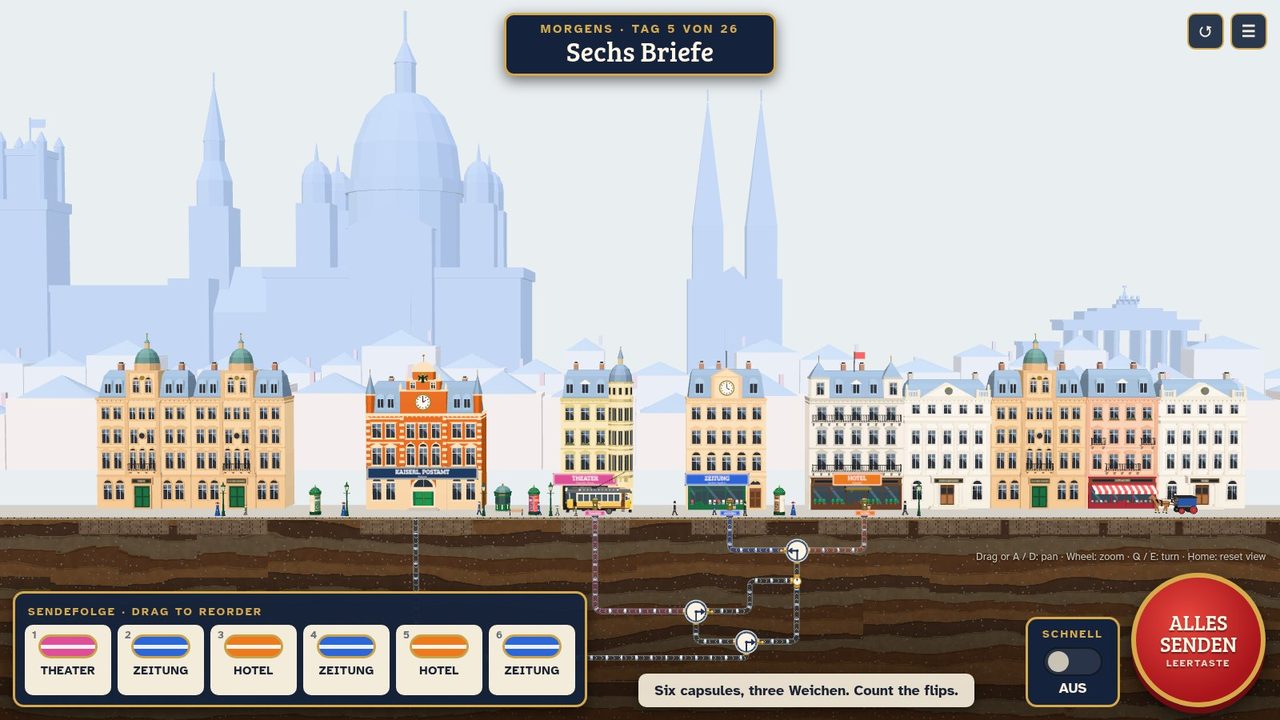
“But overall I still don't think I like staring at dirt the entire time. Like, where I'm doing my work is down below in the dirt, where all the cool stuff is happening above.”

“I think we go with the map view, but learn from the things that worked well here.”

Sibi, after playing both
Unter Berlin zoomed out: the camera rises to show the skyline with the Dom Play Unter Berlin

The losing build, frozen the moment it lost. 26 levels.

IV · Growing up

Level 1, fifteen times

The same first level, two capsules and one diverter, from the 37-minute prototype to the build that was handed in. Drag the slider or use the arrow keys.

V · Models

Built from recipes

No mesh in the game was generated. Every model is a Blender script that an agent wrote and ran: start from a cube, cut it, extrude, scale, inset, colour from one shared palette. Sibi judged every piece on the board, from the capsule to the counter whose lamps kept floating, and had the landmarks rebuilt from period photos and plans at one scale: 1.5 times real size, like the houses of the plan.

Turn them yourself. Drag to orbit, scroll or pinch to zoom.

Loading the model…

    Watch the Berliner Dom being built

    The Dom as it stood in 1905, from a recipe of 347 steps. Every step is the real model right after that line of the recipe ran; the orange faces are the ones the next line will work on.

    347of 347 steps
    Windows and ribs
    2,644 triangles
    Loading the recipe…
    berlin_dom.py

      VI · Experiments

      Zugestellt or unzustellbar

      The rule once the game was chosen: an experiment never hides behind a switch in the game. It gets its own workspace and its own build, replaces the old thing outright, and only merges if Sibi accepts it. Some made it.

      VII · The control room

      229 tickets, three lines each

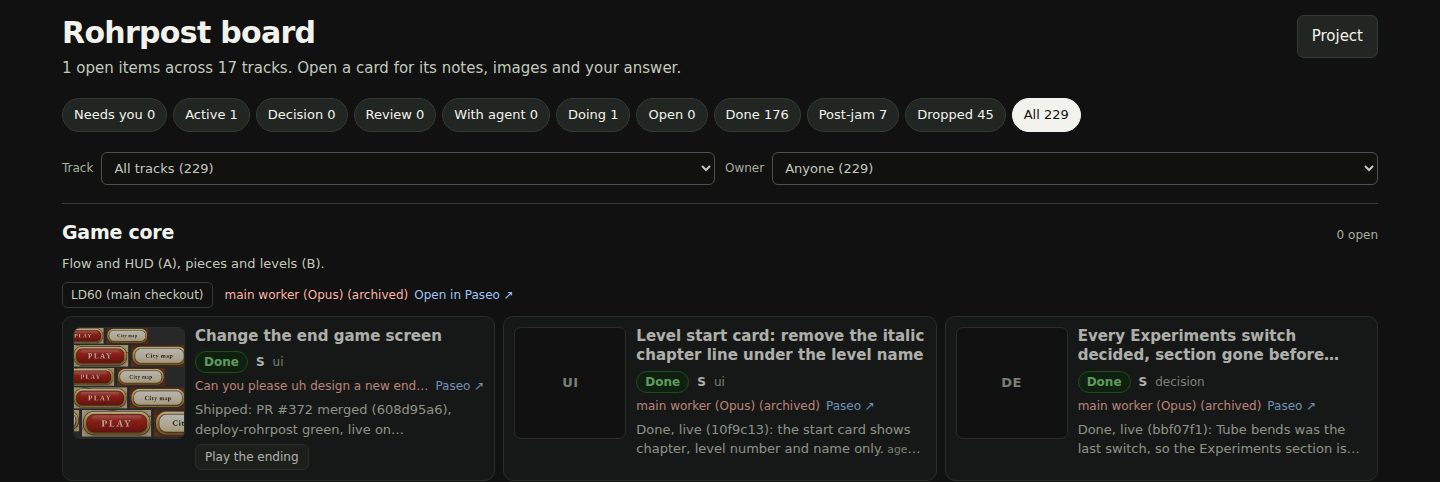
      A day and a half in, the loop broke: an hour of dictated feedback, then two hours of waiting for builds. “Things are taking very long and I feel a bit out of the loop.” An agent built a board into Sibi's Hub within minutes, and the way of working changed for good.

      Every element of the game became a ticket owned by one agent. Agents could ask Sibi two things only: review this or decide this, always in three short lines. Sibi answered by dictating straight onto the ticket, and the answer went into the owning agent's chat. In the first hour and a half of that Sibi answered 40 times.

      • 229 tickets
      • 176 done
      • 45 dropped
      • 1,149 notes
      • 342 review images
      The Rohrpost board in the Hub: filters for Needs you, Done 176, Post-jam 7, Dropped 45, All 229, and the first ticket cards
      The board at the end of the jam: nothing waiting on Sibi.

      VIII · Conversations

      What directing agents sounds like

      Twelve exchanges, in the order they happened. Sibi's lines are dictation, kept as spoken. The replies are the agents' own first words back.

      IX · Eras and sound

      Three Berlins, three tunes, one voice

      The eras came from reading up on the history of the pneumatic post: “I like it starting very old-timey, sepia, but then kind of as you mature out of the tutorial ... you get into the much nicer looking bits.” The first try was a colour filter and failed. The overnight rebuild changed only the city: each era is traced from a real plan of its time, the landmarks rise in the year they were built, horse trams give way to electric trams and then to buses.

      The music is written as notes and played with sampled CC0 instruments, one piece per era, tuned until it was calm enough to stay in the background. “The polka is the music people hear the most. This is what we open with.”

      “Zugestellt!”

      After every solved level a voice calls out the stamp. The generated German voices sounded wrong to Sibi: “Most of the German ones that you recommend are very sad. Like this would be a very exciting thing that happens, right?” So Sibi recorded their own, in the middle of a dictated message. “Like the later ones, I actually draped a blanket over me, so they should be better.”

      Five takes ship in the game, never the same one twice in a row. To a friend who played it: “Yeah ich hasse es meine Stimme zu hören. Aber AI klingt auch nicht viel besser.” I hate hearing my own voice. But AI doesn't sound much better either.

      Synthesized in code

      Every effect is a small function that writes a waveform. When the sound agent offered redesigns, the originals mostly won: “Revert, please, all of them to old.”

      The ending: a postcard with a stamp for every level, then the big one. “This is the big payoff at the end, so it should be unskippable. Like you spent probably almost an hour getting here.”

      Now play it

      Thirty-one levels, three Berlins, one lever. The last three levels are meant to be hard: “And I'm against adding any hints.”

      Play Rohrpost